The point is not to dispense with human inspectors, but to reduce their exposure to unnecessary risks, automate data collection, and allow skilled workers to make better decisions based on the information the drones have gathered.
Andrew Mabry, Technology Researcher and Analyst | ZenaDrone
Manufacturing facilities are growing more automated by the day, but inspection is an area where employees often have to manually check equipment, storage locations, rooftops, structures, and other hard-to-reach places to see whether something needs their attention. The problem with this status quo is not only the amount of time it takes to perform these kinds of inspections. Some inspection routes can put people at risk of falling from heights, getting hit by machinery, crawling through tight spaces, or working in dangerous temperatures. At the same time, an inspection is only as useful as the information it produces gets to maintenance and operations teams in a timely manner in order to inform a decision.
This is why AI-powered autonomous drones can offer another option. Rather than seeing indoor inspection, outdoor inspection, data collection, and maintenance reporting as different tasks, manufacturers can use UAV technology as a mobile sensing layer that can gather visual and sensor data from different parts of a facility.
The point is not to dispense with human inspectors, but to reduce their exposure to unnecessary risks, automate data collection, and allow skilled workers to make better decisions based on the information the drones have gathered.
How AI-Powered Drone Technology Works
An industrial drone can consist of more than just an aircraft carrying a camera. It may comprise cameras, navigation sensors, obstacle detection sensors, local processing, communications and control capabilities, and autonomous navigation software or AI. In a common inspection scenario, the operator first defines a mission. Following its defined path or navigating through a specified area, the sensors on the drone capture images, videos, location data, or other relevant inspection information.
This inspection data can then be fed into AI or computer vision software. In place of or in addition to human data inspectors analyzing each photograph taken during each mission, software can identify variances in photographs, categorize items and text captured, or distinguish specific items for subsequent examination.
This creates a practical workflow:
Plan → Fly → Capture → Analyze → Review → Act
The last two steps are especially important. Although AI can help filter information, technicians are still responsible for deciding if a reported condition needs further inspection and testing, whether an inspection merits a repair, needs monitoring, or nothing. This coupling of autonomous mobility with detection through senses, with processing enabled by AI and human decision-making, provides a significant advantage for the industrial world.
Features of AI-Powered Inspection Drones
- Autonomous Navigation: Follows planned inspection routes with minimal manual control.
- Obstacle Detection: Identifies and avoids structures, equipment, and other obstacles.
- High-Resolution Imaging: Captures detailed visual data for asset inspection.
- Thermal Monitoring: Detects unusual heat patterns requiring further investigation.
- AI-Assisted Analysis: Flags potential anomalies and changes for human review.
- Indoor & Outdoor Operation: Supports different inspection workflows across industrial environments.
- Real-Time Data Transmission: Sends inspection data to teams for faster review and decision-making.
Indoor Inspections: Operating Where GPS Is Unavailable
Flight in indoor manufacturing settings differs drastically from open-air facilities.
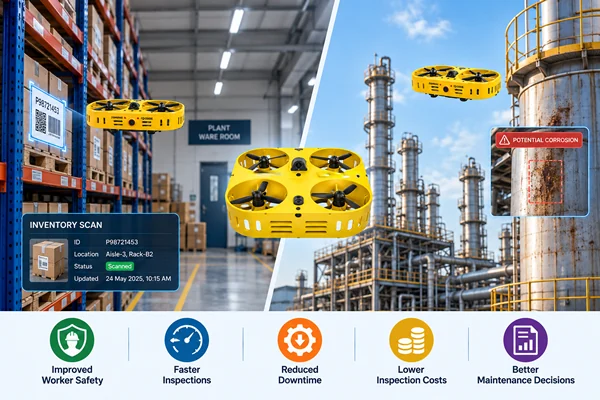
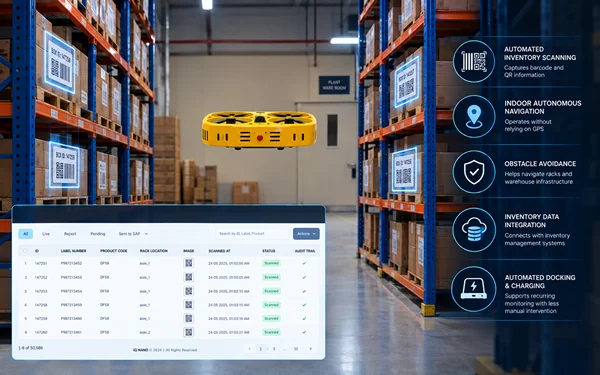
GPS might not work indoors in factories and warehouses, so a drone should be able to analyze the environment around it and ensure safe movement. It depends on the particular solution, but it can include visual recognition, positioning of the drone, computer vision, object detection and pre-programmed routes. Such technologies can be used for inspection of hard-to-reach areas in a building, like warehouse racks, structures, roof installations, surroundings of machinery and so on. Routine manual inspection of those areas requires additional tools such as ladders or lift machines.
Moreover, drones can be utilized for inventory-related purposes.
Cameras and sensors can scan QR codes and barcodes on products or any items and upload that information to inventory or enterprise management systems rather than entering the data manually afterwards.
An actual use case of this type of application is ZenaDrone IQ Nano. According to the official specs, it operates without GPS indoors, has high-resolution scanning of barcodes and QR codes, obstacle avoidance, visual data collecting capabilities, integrates with API, uploads data to SAP systems, stores information in the cloud, and has an automated charger and intelligent batteries. Specified time of autonomous flight is up to 20 minutes
These capabilities illustrate how AI-Powered Inspections Drone Technology can move beyond simply taking aerial photographs. In an indoor setting, the UAV can become part of the facility's data-collection process.
Outdoor Inspections Require a Different Approach
Once in operation beyond the facility, the operating environment differs.
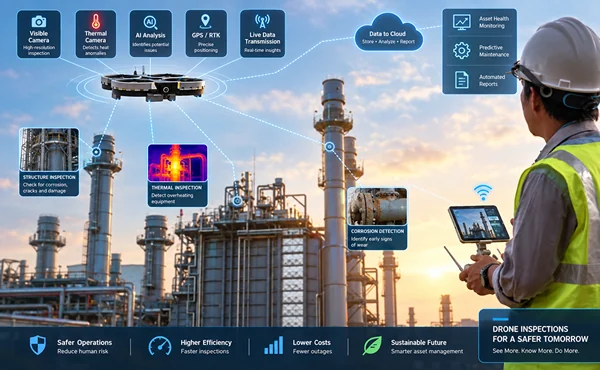
Manufacturing campuses could see rooftops, external structures, storage areas, tanks, utilities, worksites, perimeter assets, pipelines, or equipment scattered over a much larger area. Outdoor UAVs can utilize GPS or set routes of travel to survey the asset from repeatable vantage points. Based on the drone and payload, high-resolution cameras, thermal imaging, LiDAR, or other sensors could be utilized to gain insight typically requiring a person to view the asset.
The real opportunity for manufacturers is not simply the utilization of an outdoor drone. Instead, it is tying the data captured from outside the building to the same maintenance process utilized by the conditions observed inside the plant.
Visual and Thermal Data Provide Different Information
Visual and thermal imaging provide different layers of information during drone inspections. High-resolution cameras can document corrosion, physical damage, missing components, surface changes, roof conditions, and structural issues, allowing technicians to review hard-to-reach assets remotely.
Thermal cameras add another layer by detecting infrared radiation and showing temperature differences across equipment and surfaces. These patterns can help teams identify areas that may require closer investigation.
- Heat Detection: Identifies unusual temperature patterns.
- Early Warning: Highlights potential overheating or faults.
- Remote Inspection: Checks difficult-to-access equipment safely.
- Maintenance Support: Helps teams prioritize further inspection.
Thermal results are not a final diagnosis. Weather, equipment load, surface conditions, and viewing angle can affect readings. Thermal imaging simply helps technicians identify areas that need closer inspection before making a final decision.
AI Turns Inspection Data Into Priorities
Drone inspections result in a huge number of images, video sequences, and sensor data at different manufacturing facilities. Artificial intelligence and computer vision can assist in processing such a large amount of data by recognising objects, comparing past inspections with current ones, detecting changes, and reporting potential discrepancies. This leads to a reduction in the time that staff spend on manually searching for issues in a mass of data.
On top of just detecting discrepancies, artificial intelligence can also highlight the most critical findings first, allowing the maintenance staff to start with the most important ones.
Besides, artificial intelligence is meant to assist the decision-making process rather than replace human technicians' or engineers' expertise. AI is a very useful tool for the review of findings, planning of maintenance work, as well as identification of emerging issues.
Operational Impact of AI-Powered Drone Technology
- Improved Worker Safety: Reduces the need for employees to enter hazardous, elevated, or hard-to-reach areas.
- Faster Inspections: Covers large or difficult areas faster than many routine manual inspection methods.
- Reduced Downtime: Helps identify potential issues earlier, allowing maintenance teams to respond before problems escalate.
- Lower Inspection Costs: Reduces repetitive manual work and the need for access equipment for some preliminary inspections.
- Better Maintenance Decisions: Provides repeatable visual, thermal, and AI-assisted data to help teams prioritize maintenance and repairs.
One Inspection Workflow Across Indoor and Outdoor Assets
The most valuable long-term model is not an “indoor drone program” and an unrelated “outdoor drone program.”
It is one inspection strategy that leverages different UAV capabilities for different environments.
Inside a facility, a compact system may navigate without GPS, scan inventory, take visual records, and inspect hard-to-reach locations.
Outside, another UAV configuration may travel greater distances, follow GPS-specific routes, inspect elevated infrastructure, or carry specialized imaging sensors.
The information from both environments can then enter a common operational process.
For example, an indoor mission could flag a visual change around an elevated component, and an outdoor mission could flag an abnormal condition on a roof or external utility asset. Both observations can be stored with timestamps, asset references, images, and mission records.
The maintenance team can review the flagged observations, determine priority, conduct any required hands-on testing, and create the appropriate work order.
That is more valuable than just owning a drone, as it connects aerial automation to an existing maintenance decision.
Real-Time Information Can Reduce the Inspection Delay
A traditional inspection can involve a lot more than the inspection itself.
Access equipment may need to be acquired, an area shut down or isolated, staff may have to traverse an entire complex before the initial finding is made, notes compiled, a workstation revisited before even getting back to that station to write up a report before the information finally arrives at someone who can make a decision.
A UAV may cut out some parts of this process.
If a system is enabled for live or near-real-time transmission, personnel may monitor what is happening visually while still undertaking the mission, and if something requires a closer look, the UAV may be repositioned prior to the termination of the mission. Indeed, Zena Drone mentions real-time aerial visual information, autonomous monitoring & scanning, and AI/computer-vision enabled analysis as part of its wider UAV proposition.
Saving Employee Time Without Removing Employees
Automation discussions sometimes frame the benefit as replacing labor. For industrial inspection, a more practical objective is to use skilled labor where it adds the most value.
Consider an employee who needs to inspect a high structural point. The actual technical judgment may take only a few minutes, while preparing access equipment, reaching the location, documenting it, and returning safely can take considerably longer.
Real-world warehouse deployments reported by ManufacturingTomorrow demonstrate this labor-reallocation principle. In one 2026 deployment, autonomous inventory drones allowed approximately 60–70 labor hours per week per site to be redirected from manual cycle counting to other operational priorities. That is an inventory example rather than a general inspection benchmark, but it demonstrates how autonomous aerial data collection can change where employee time is spent.
Reducing Human Exposure to Industrial Hazards
Initial site inspections carried out by the drone can keep workers out of heights, extreme temperatures, enclosed spaces, moving machinery, and many other dangers. Technicians can access confined spaces with more preparation and knowing what it is they're getting themselves into. This system uses the drone as a preliminary "worker" without diminishing the role of the human specialist- send the sensor in first; the human can deal with physical requirements later.
Where Human Expertise Still Matters
Autonomous inspections support rather than replace skilled professionals. AI, cameras, and thermal sensors can identify potential issues, but environmental conditions, navigation challenges, and false detections can affect results.
The most effective approach is drone plus technician: drones collect repeatable inspection data, software prioritizes findings, and experienced personnel verify results and make final maintenance or safety decisions.
What Manufacturers Should Evaluate Before Deployment
Before initiating an autonomous inspection solution, manufacturers should start with the inspection problem itself rather than the aircraft.
Manufacturers should identify where inspections are repetitive, time-consuming, difficult to reach, or unnecessarily hazardous for employees. Then they can analyze the sensing, navigation, data, and integration needs of the tasks.
Indoor facilities might have needs for GPS-free navigation and good obstacle detection, whereas outdoor operations could be required to have high endurance, weather resilience, GPS-based path planning, or a special payload.
Conclusion
AI-powered drones are revolutionizing businesses outside of the manufacturing sector. From national defense and security to agriculture, emergency management, power grids, transport, industrial inspections, and commercial operations, UAVs are being used for monitoring and collecting data for a multitude of industries. With the developments in these cutting-edge machines, the need for monitoring operations is being replaced by more efficient, AI-driven drone operations. ZenaDrone develops autonomous UAV technology that combines AI, computer vision, sensing, and real-time data capabilities for industrial inspection, monitoring, and related operational applications.
Andrew Mabry: a technology researcher and analyst at ZenaDrone, specializing in UAV and drone technology, artificial intelligence, machine learning, automation, and emerging digital technologies. Through his research and writing, he translates complex technological developments into clear, practical insights for readers and industry professionals.