Pick one outcome that matters, get clean data at the edge, apply intelligence only where it changes a decision, close the loop with the people doing the work, prove it on one line, and measure the result in the language the plant already speaks.
Zakary Smith and Dr. Yen Chang | SensFlo
Walk any trade show floor in 2026, and you will hear the same promise from a hundred booths: artificial intelligence is about to transform your plant. Walk the actual plant floor a year later, and the results are a far cry from the revolution described a year ago. More often than not, you’ll find a pilot that ran for a quarter, produced a dashboard nobody opens, and was politely shelved when the champion who sponsored it moved on.
This gap between the promise and the plant is the central problem of manufacturing AI right now, and it is not primarily a technology problem. The models are good enough. The sensors are cheap enough. What separates deployments that stick from those that stall is the mindset behind the work — starting from the operational outcome and building back toward the data, rather than starting with a model and hunting for a place to put it.
We have built AI systems for manufacturers across metals, plastics, and precision machining, and we have watched both patterns up close. What follows is what we have learned about why floor-level AI fails, plus a practical playbook for making it useful. A solution one any operations leader can apply regardless of which vendor, platform, or algorithm they choose.
Why most factory-floor AI fails
The failures are remarkably consistent. They cluster into four causes, and none of them is "the AI wasn't smart enough."
It starts with the model, not the problem. The most common way a project dies is that it began as a technology initiative rather than an operational one. Someone was tasked with "doing something with AI," so they went looking for a use case to justify a capability. This thinking is all backward. People don’t want AI for AI’s sake. They want changeovers to take less time, scrap rates to come down, and unplanned downtime to stop eating third shift. When a project can't name the specific number it will move, it has no anchor, and a project without an anchor is a science experiment. Science experiments get defunded.
The data isn't there or isn't trustworthy. Manufacturers are often told they are sitting on a goldmine of data. In practice, the data is fragmented across a thirty-year-old PLC, a newer MES that only some lines feed, a quality system that lives in spreadsheets, and the tribal knowledge in a veteran operator's head. Even where data exists, it is frequently mislabeled, unsynchronized, or sampled too coarsely to see the event that matters. An AI model trained on this is not intelligent; it is confidently wrong. The unglamorous truth is that most of the value in a manufacturing AI project comes from getting clean, time-aligned, contextualized data in the first place — the model is the easy part.
The integration tax is brutal. Factories are brownfield environments. The equipment was never designed to talk to a cloud platform, half of it predates Ethernet, and the OT network is (correctly) walled off from IT for safety and security reasons. A pilot that works beautifully on a single instrumented cell can collapse when it meets the reality of connecting to forty heterogeneous machines, each with its own controller, protocol, and quirks. Teams routinely underestimate this by an order of magnitude, and the project runs out of budget and patience before it ever reaches scale.
Operators don't trust it, so they don't use it. This is the failure mode that gets discussed least and kills the most deployments. A system that hands an operator a recommendation with no explanation, that cries wolf with false alarms, or that seems designed to grade their performance will be quietly ignored — or worse, gamed. The people on the floor have decades of hard-won judgment, and any tool that treats them as a problem to be automated around loses the room immediately. If the line operator doesn't believe the system and act on it, the most accurate model in the world produces exactly zero dollars of value.
Notice that three of these four failures have nothing to do with data science. They are about problem selection, data plumbing, systems integration, and human trust. That is the real terrain of factory AI, and it is why the winning approach looks less like a research project and more like disciplined operations engineering.
The shift: from "AI project" to "operational outcome"
The single most useful reframe we can offer is this: stop running AI projects and start running outcome projects.
An AI project asks, "Where can we apply this model?" An outcome project asks, "Which number on the plant scorecard do we need to move, and what is the shortest path to moving it?" AI may or may not be part of that path. When it is, it earns its place by contributing to a measurable result a plant manager already cares about: overall equipment effectiveness, unplanned downtime hours, first-pass yield, energy per unit, on-time delivery.
This reframe changes everything downstream. It tells you which data actually matters (only the data that bears on the target outcome), how good the model needs to be (good enough to change a decision, not good enough to publish a paper), and how you will know if you succeeded (the number moved, or it didn't). It also keeps the people who own the outcome — operations, not IT — in the driver's seat, which is where sustainable deployments live.
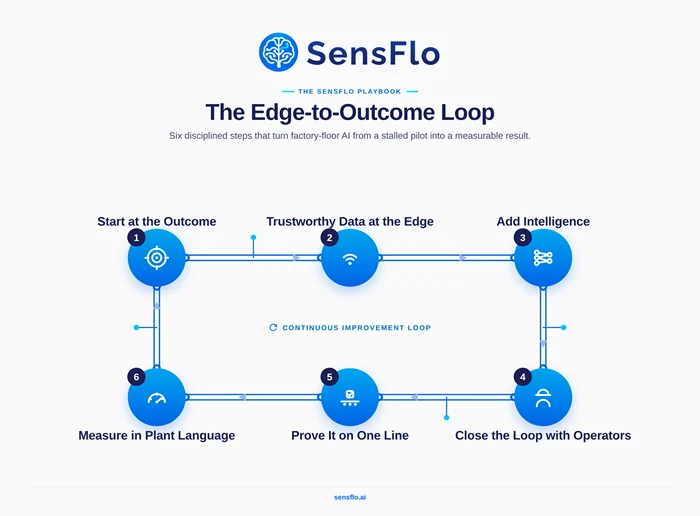
The edge-to-outcome playbook
Here is the practical sequence we have seen work, from first conversation to a system that is still running two years later.
1. Start at the outcome and work backward. Pick one painful, quantifiable problem on one line. Not "improve the plant with AI.” Something like "cut unplanned downtime on the extrusion line by 20 percent" or "reduce changeover time on the press." Write down today's baseline number before you touch any technology; you cannot prove improvement you never measured. A narrow, concrete target is not a limitation; it is what makes the whole thing legible to everyone from the operator to the CFO.
2. Get trustworthy data at the edge. Most of the events that matter on a factory floor happen in milliseconds and in places with poor connectivity. That is why the smart money on the sensing layer is increasingly at the edge — capturing and processing data on or beside the machine rather than shipping everything to a distant cloud and hoping the network keeps up. Edge processing buys you four things that matter enormously in a plant: low latency (you can react to an event as it happens, not seconds later), resilience (the line keeps being monitored when the internet drops), lower cost (you send summaries, not raw firehoses of vibration data), and a cleaner security posture (sensitive process data can stay on-premises). The goal at this stage is not intelligence yet, but a clean, time-synchronized, well-labeled stream of what the machine is actually doing. Make installation something a maintenance tech can do in minutes, not a six-week integration engagement, or you will never get past one line.
3. Add intelligence where it changes a decision. Only now does the model come in, and its job is narrow: turn the clean data stream into something that changes what a human or a machine does next. Sometimes that is anomaly detection that flags a bearing starting to fail before it takes the line down. Sometimes it is a pattern that explains why yield drops every time a particular material lot meets a particular ambient humidity. The test for whether the intelligence is worth anything is simple: does it change a decision that changes the outcome? If it produces an insight nobody acts on, it is a very expensive screensaver.
4. Close the loop with the operator, not around them. Deliver the output where the work happens, in language the floor already uses, with enough context that the operator understands why. Tell them the extruder is trending toward a fault and show the trend; don't just fire a red alert. Let the veterans correct the system when it is wrong. This feedback is training data and trust-building at the same time. The measure of a good floor-level AI system isn't its model accuracy; it is whether people on the line reach for it during a problem instead of ignoring it. Systems that make operators faster and smarter get used. Systems that seem to be watching them get switched off.
5. Prove it on one line, then earn the right to scale. Run the loop on your single target until the baseline number has demonstrably moved and the operators on that line would object if you took the tool away. That result (a real, defended improvement on a real line) is your business case for the next ten lines, and it is worth infinitely more than a glossy proof-of-concept. Scaling then becomes a repeatable rollout, not a fresh act of faith each time.
6. Measure in the plant's language. Report results in OEE points, downtime hours recovered, scrap avoided, throughput gained: the metrics that already hang on the wall. When AI's contribution is expressed as model F1 scores or data volumes, the plant tunes out. When it is expressed as "we recovered eleven hours of runtime on line three last month," it gets funded and expanded.
What "useful" actually looks like
Useful AI on the factory floor is almost boring in practice, and that is the point. It looks like a monitoring layer that installs in minutes and starts giving an accurate real-time picture of utilization and downtime across every shift — surfacing, often for the first time, exactly where the hours are being lost. It looks like an alert that reaches a maintenance tech before a stoppage instead of after. It looks like an operator glancing at a screen, seeing a trend, and making a small adjustment that keeps a good part good. It looks like a plant manager walking into the Monday meeting with the same numbers everyone already argues about — except now they are real, current, and trusted, so the argument becomes a decision.
None of that requires the operator to know or care that a model is running underneath. The AI has done its job precisely when it has disappeared into the work.
Where this is heading
The frontier we find most interesting is the shift from selling manufacturers tools to delivering them outcomes. For decades, industrial software has been sold as capability: here is the platform, here are the features, good luck getting value out of it. The failure rate we described at the top of this article is, in part, a symptom of that model. It’s the burden of turning capability into results landed entirely on already-stretched plant teams.
The more durable arrangement ties the provider's success to the plant's. When the relationship is structured around a committed outcome — a guaranteed reduction in downtime, a floor of utilization improvement — the incentives finally point in the same direction. The vendor is motivated to solve the unglamorous data, integration, and adoption problems, because they only win when the number moves. We believe this outcome-oriented model, more than any single algorithmic advance, is what will finally close the gap between AI's promise and the plant floor.
The takeaway
Making AI useful on the factory floor has very little to do with having the best model and almost everything to do with discipline: pick one outcome that matters, get clean data at the edge, apply intelligence only where it changes a decision, close the loop with the people doing the work, prove it on one line, and measure the result in the language the plant already speaks. Do that, and AI stops being the thing you piloted last year and becomes the thing you can't imagine running the line without.
The technology is finally ready. The question is no longer whether AI can help on the factory floor — it is whether we are willing to deploy it the way the floor actually works.
 Zakary Smith is Co-Founder and CEO of SensFlo, an industrial AI company building real-time machine monitoring and production intelligence for manufacturers. A product-launch specialist, he has taken more than 100 innovations from concept to production, including work on the Tesla Model 3 and the Samsung smartwatch. He is based at SensFlo's headquarters in Woodland Hills, California.
 Dr. Yen Chang is Co-Founder and CTO of SensFlo. He holds a PhD from UCLA in precision controls, robotics and artificial intelligence where he continues to serve in an active lecturing role. His research is put into practice informing SensFlo's approach to edge-based production AI intelligence.